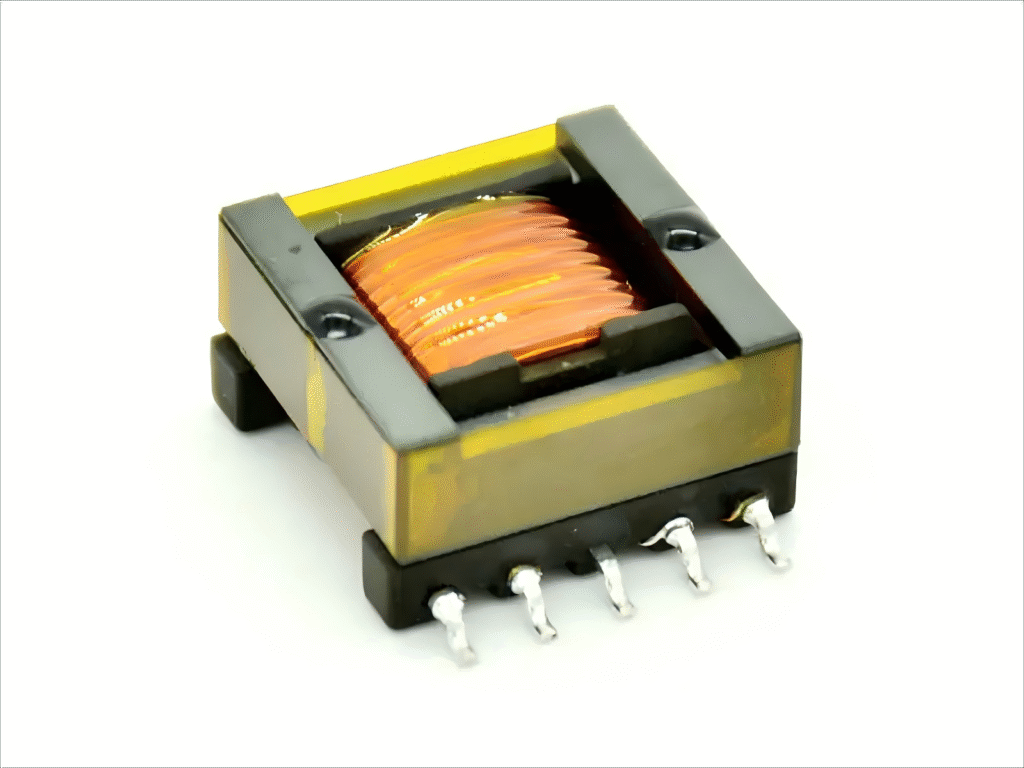
- Basic Introduction
A high‑frequency transformer is a special transformer that works at high frequency (typically from 1 kHz to several MHz). It is widely used in switching power supplies, inverters, and electronic equipment, with features of small size, light weight, and high efficiency. - Components / Structure
The main components of a high‑frequency transformer include:
Magnetic core
Usually made of ferrite, nanocrystalline, or amorphous material, which has low loss at high frequency and supports efficient magnetic flux transmission.
Primary winding
The input coil connected to the high‑frequency AC power source.
Secondary winding
The output coil that provides the desired voltage to the load.
Bobbin (skeleton)
An insulating support used to fix the windings and core.
Insulation materials
Used between layers and windings to ensure isolation and voltage resistance.
Mounting pins / base
For soldering the transformer onto a PCB. - Working Principle
The working principle is based on Faraday’s Law of Electromagnetic Induction, but optimized for high‑frequency conditions:
1)A high‑frequency alternating voltage is applied to the primary winding.
2).It generates a high‑frequency alternating magnetic flux in the magnetic core.
3).This changing magnetic flux induces a high‑frequency alternating voltage in the secondary winding.
4).The output voltage ratio is approximately equal to the turns ratio of the primary and secondary windings:
V p /Vs ≈Np /N8
5).At the same time, it provides electrical isolation between input and output, blocks DC components, and transfers energy efficiently.
Compared with low‑frequency transformers, high‑frequency versions use special low‑loss cores and tighter winding structures to reduce eddy‑current loss, skin effect, and proximity effect. - Main Functions
Voltage transformation: Step‑up or step‑down high‑frequency AC voltage.
Electrical isolation: Physically separate input and output circuits for safety and noise reduction.
Energy transfer: Transmit power efficiently in switching circuits.
Impedance matching: Match impedance between the power stage and the load to improve efficiency. - Typical Applications
Switching Mode Power Supplies (SMPS): Chargers, adapters, and computer power supplies.
DC‑DC converters: Industrial power modules, battery systems.
Inverters: Solar inverters, vehicle inverters, UPS.
High‑frequency lighting: Electronic ballasts, LED drivers.
Industrial power supplies: Welding machines, high‑frequency heating equipment.
Communication & medical equipment: Isolated power supplies for precision circuits.