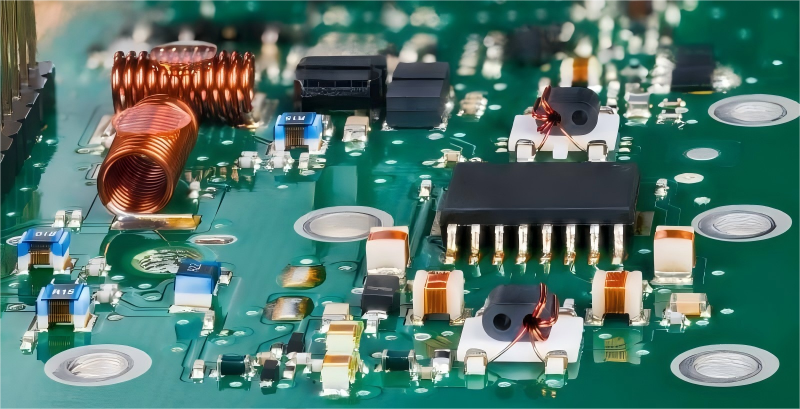


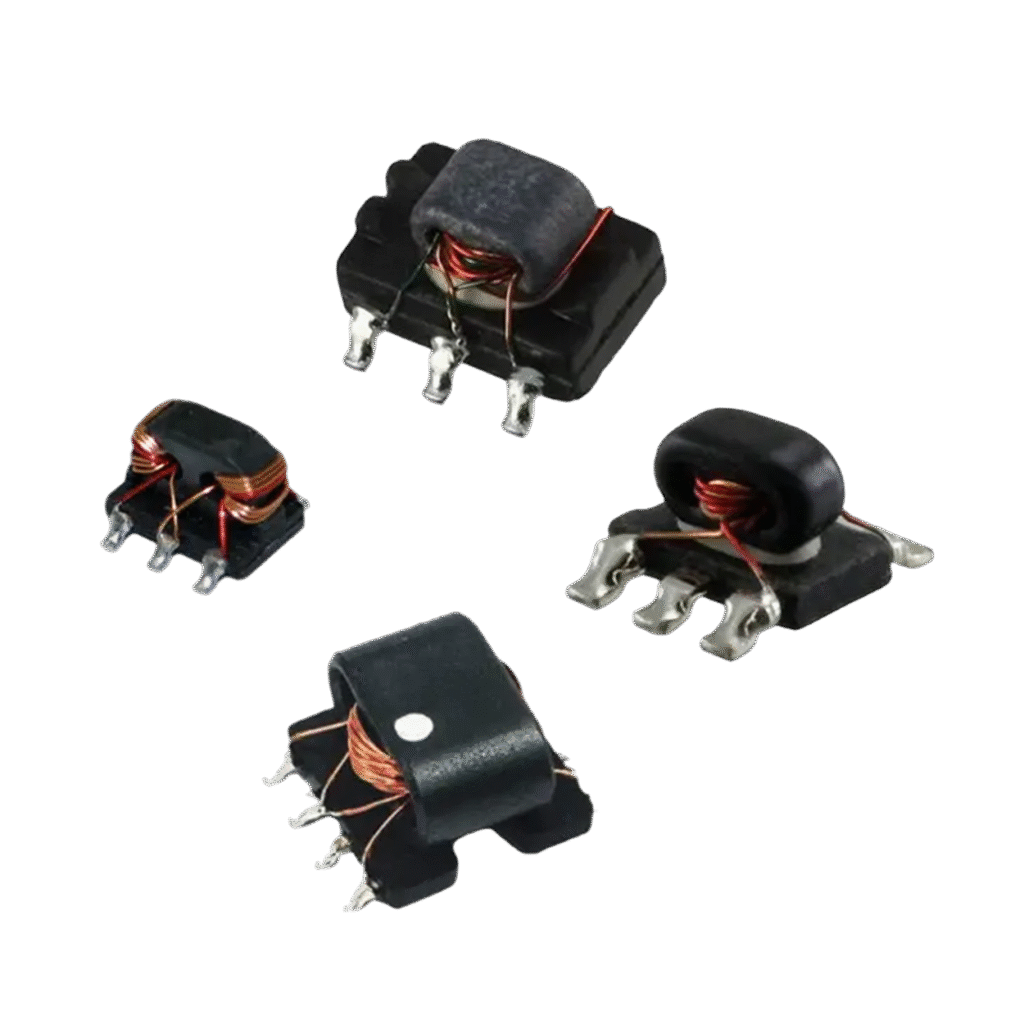
- Core Parameters Overview
RF Transformers
Frequency Range: Typical 10 kHz–8 GHz (wideband types up to 20 GHz for microwave and mmWave systems)
Impedance: Standard 50 Ω / 75 Ω; common impedance ratios: 1:1, 1:2, 1:4, 4:1
Key Performance: Impedance matching, balanced-unbalanced (balun) conversion, low insertion loss, high isolation, minimal signal reflection
Power Dividers
Frequency Range: 0.1 MHz – 50 GHz (commercial: 700 MHz – 6 GHz; microwave: up to 40 GHz)
Impedance: Mostly 50 Ω; 75 Ω for broadcast and CATV systems
Key Performance: Equal/unequal power splitting, low insertion loss, high port-to-port isolation, low VSWR, flat in-band response
Directional Couplers
Frequency Range: 700 MHz – 40 GHz (mainstream communication: 700 MHz – 6 GHz)
Impedance: Uniform 50 Ω
Key Performance: Fixed coupling ratio (6 dB, 10 dB, 20 dB, 30 dB), high directivity, low insertion loss, signal sampling/monitoring - Roles in Communication Equipment
These passive RF components form the signal distribution and matching backbone of modern wireless systems:
RF Transformers
Match impedance between chips, antennas, power amplifiers (PAs), and low-noise amplifiers (LNAs)
Convert single-ended to balanced signals and suppress common-mode interference
Improve power efficiency and reduce signal distortion in transceiver frontends
Power Dividers
Distribute one RF input to multiple antenna paths or receiver chains
Combine multiple signals in MIMO and beamforming systems
Support multi-band / multi-operator signal sharing in DAS and small cells
Directional Couplers
Sample forward/reverse power for monitoring and protection
Extract test signals without breaking the main link
Stabilize transmission quality and prevent PA damage from reflected power
Together, they ensure low loss, high isolation, stable impedance, and clean signal distribution in 4G/5G, Wi-Fi 6/7, satellite, and IoT systems. - Product Applications with Leading Chipsets
Qorvo
RF Transformers & Baluns: Match Qorvo PAs/LNAs in 5G base stations, massive MIMO, and Wi-Fi 7 front ends
Power Dividers: Used with Qorvo’s mmWave and sub‑6 GHz front-end modules (FEMs)
Directional Couplers: Monitor power in Qorvo-based satellite terminals, radar, and mobile radios
Scenarios: 5G macro/small cells, Wi-Fi 7 APs, automotive radar, SatCOM CPE
Microchip
RF Transformers: Support impedance matching in Microchip’s ISM band, Sub‑1 GHz, and industrial RF transceivers
Power Dividers: Distribute signals in Microchip-powered smart metering, remote monitoring, and IIoT
Directional Couplers: Protect transmitters in industrial wireless and public-safety radios
Scenarios: Industrial IoT, smart grid, wireless sensors, rugged radio
Qualcomm
RF Transformers: Optimize antenna interface for Qualcomm 5G modems, RF transceivers, and Snapdragon platforms
Power Dividers: Enable MIMO in smartphones, CPEs, fixed wireless access (FWA)
Directional Couplers: Stabilize power control in mobile and portable 5G devices
Scenarios: 5G smartphones, FWA CPE, residential gateways, drones
Broadcom
RF Transformers: Match lines in Broadcom Ethernet, optical front haul, and high‑speed wireless. SoCs
Power Dividers: Signal distribution in carrier Wi-Fi, DAS, and small-cell systems
Directional Couplers: Link monitoring and linearization in high-power PAs
Scenarios: Enterprise APs, DAS, 5G backhaul, optical transport
Xilinx (AMD)
RF Transformers: Interface Xilinx RFSoC ADC/DAC with analog front ends
Power Dividers: Route multi-channel signals in SDR, 5G prototyping, and radar systems
Directional Couplers: Calibrate and monitor high-speed RF links
Scenarios: 5G test beds, SDR platforms, 6G research, radar, electronic warfare - Typical Application Scenarios
Mobile Communication: 5G macro/small cells, DAS, antennas, beamforming
Wireless LAN: Wi-Fi 6/7 APs, high-power MIMO, enterprise routers
Satellite & Automotive: SatCOM terminals, V2X, millimeter-wave radar
Industrial & IoT: Sub‑1 GHz, remote telemetry, smart metering, IIoT
Test & Measurement: SDR, signal simulation, spectrum monitoring, lab validation
These passive components are indispensable for realizing stable, efficient, and high-performance RF systems alongside chips from Qorvo, Microchip, Qualcomm, Broadcom, and Xilinx.
Passive Components solution—TV Tunner